
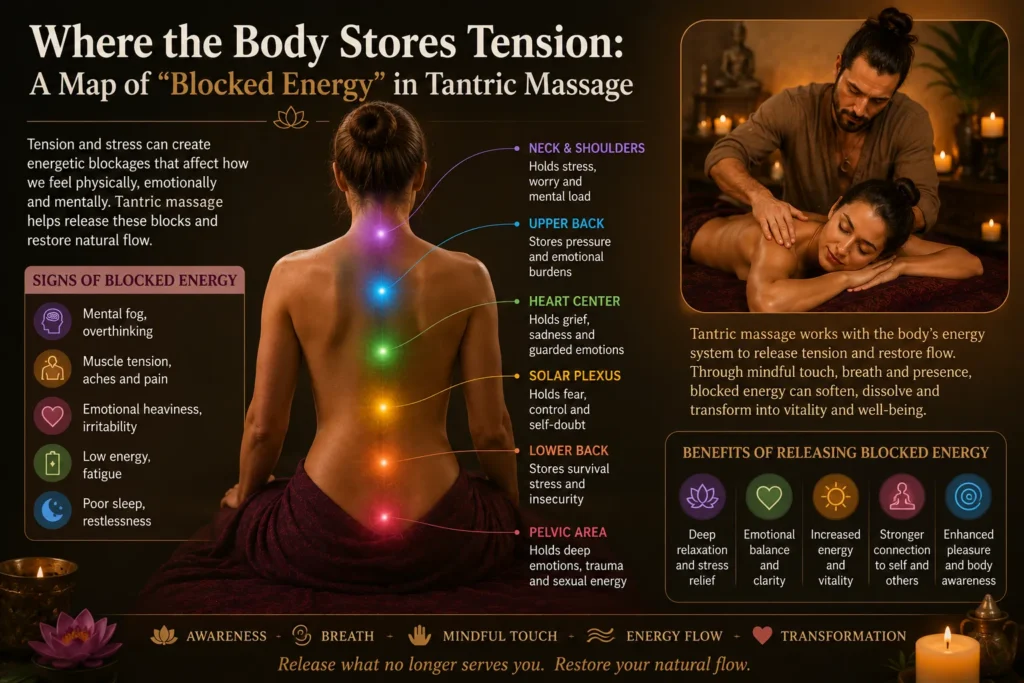
Where the Body Stores Tension: A Map of “Blocked Energy” in Tantric Massage
A Phrase That Sounds Mystical But Often Isn’t
The first time someone hears “blocked energy,” it tends to land as new-age language — vague, spiritual, hard to pin down. But strip away the terminology, and what’s being described is usually familiar to almost everyone: a shoulder that never quite drops, a jaw that stays clenched without you noticing, a chest that feels tight even when nothing is technically wrong.
In tantric bodywork, “blocked energy” is really shorthand for these everyday holding patterns — the places where stress, guardedness, or shallow breathing seem to settle in and stay. Most people don’t describe it in energetic terms at all. They say things like “I can’t switch off,” “I’m always tense,” or “I feel cut off from my own body.”
What’s Actually Being Described
When practitioners talk about blocked energy, they’re usually pointing to a reduced sense of flow, ease, or openness in the body — something that can show up physically as tightness, mentally as restlessness, or emotionally as a kind of guardedness that’s hard to name.
In practice, this often looks like predictable patterns: tension that collects in the neck during stressful periods, tightness across the chest after emotional strain, a clenched stomach during anxious stretches, or hips that seem to brace even at rest. None of this is usually dramatic — it’s often just a habit the body has built up slowly, over years, without anyone deciding it should happen.
Translated into more familiar wellness language, this can include:
- muscular tension that doesn’t fully release with normal rest
- a nervous system that stays slightly “on” even during downtime
- emotions that get pushed down rather than processed
- breathing that stays shallow as a baseline
- a general sense of disconnection from physical sensation
- chronic overstimulation from modern life
- difficulty settling, even in calm environments
This is part of why a tantric session can feel different from a typical spa visit. Instead of only asking “where’s the knot?”, it also asks something closer to “where has this person stopped feeling fully present in their own body?”
A Rough Map of Where Tension Tends to Collect
While everyone holds stress differently, certain areas come up again and again in bodywork:
The jaw often carries things that were never said out loud — frustration, irritation, words swallowed rather than spoken.
The shoulders frequently reflect a sense of responsibility, as if someone is bracing to carry weight, literally or figuratively.
The chest can tighten around grief, vulnerability, or the instinct to protect the heart — sometimes described as feeling “closed” or “armoured.”
The stomach often contracts during anxious periods, holding a kind of low-grade alertness.
The hips are commonly linked to guardedness or long-held vulnerability, and tend to soften slowly when they soften at all.
The back, especially the lower and mid-back, often reflects sustained effort — the physical signature of “pushing through.”
It’s worth being careful here: not every tight muscle has a hidden emotional backstory. Sometimes a tense shoulder is just a tense shoulder, caused by posture, a long week, or sleeping awkwardly. Responsible practitioners don’t turn every physical sensation into a deep psychological narrative — but they also don’t ignore the well-documented overlap between emotional stress and muscular holding patterns.
Why This Isn’t About Forcing Anything
A common misconception is that tantric massage tries to “release” blocked energy through intensity — deep pressure, dramatic breathing exercises, or pushing someone toward an emotional moment. In professional practice, it’s closer to the opposite.
The approach tends to rely on:
- slow, unhurried touch
- gentle breath awareness
- grounding techniques that bring attention back into the body
- a calm, low-stimulation environment
- pacing that follows the client rather than a fixed routine
- a therapist who stays present without pushing
The body doesn’t tend to open up under pressure — it tends to close further. So instead of forcing softening, the session is structured to create the conditions where softening becomes possible, if and when the body is ready for it.
The Difference Between Feeling Relaxed and Feeling Released
These two things get used interchangeably, but they’re not quite the same.
Relaxation is often surface-level — the kind of “I feel better” you might get from any pleasant massage, lasting a few hours.
Release, in the context of tantric bodywork, tends to be described differently: deeper breathing that continues after the session, a sense of warmth or openness in areas that are usually tight, reduced mental noise, an unexpected wave of emotion or tenderness, or simply feeling more “in” your body than before.
Importantly, most sessions don’t involve a dramatic release moment — and that’s normal. Many people describe the most valuable sessions as quiet ones, where they simply leave feeling more present, less braced, and a little more like themselves.
Why Breath Keeps Coming Up
Breath is one of the most direct links between physical and emotional state. Under stress, breathing tends to become shallow and fast, often centered high in the chest. As someone begins to feel safe and settle into a session, breathing usually deepens on its own — without anyone “trying.”
In tantric work, breath awareness isn’t a separate exercise bolted onto the massage. It’s woven through the whole session. A therapist might gently draw attention to the breath, encourage a longer exhale, or simply give space for someone to notice how they’re breathing in the first place.
This matters because pressure and touch alone often aren’t enough. Many people only begin to release tension when touch, breath, and a sense of safety are present together. A slow exhale can soften a tight stomach. A relaxed breath can ease a raised shoulder. And often, simply noticing a sensation for the first time is itself part of the shift.
Is “Blocked Energy” Always Emotional?
Not necessarily — and a balanced view matters here. Sometimes what gets labeled as blocked energy is really just fatigue, poor posture, overuse, or a stretch of bad sleep. Tantra at its best doesn’t insist that every twinge has a hidden emotional meaning.
A more grounded way to think about it includes a mix of possible factors:
- straightforward physical tightness from posture or activity
- accumulated stress that hasn’t had an outlet
- a nervous system running in a low-grade alert state
- reduced awareness of bodily sensation generally
- emotions that have been set aside rather than processed
- the cumulative fatigue of a demanding lifestyle
- a sense of disconnection from others or from rest itself
- general overstimulation from constant digital and sensory input
Holding space for all of these possibilities — rather than defaulting to one explanation — is part of what separates a thoughtful practitioner from one making exaggerated claims.
Coming Back Into the Body
A lot of modern life happens almost entirely in the head — thinking, planning, responding, scrolling, problem-solving. The body often gets noticed only when something hurts or breaks down.
Tantric massage works in the opposite direction. Through slow touch, breath, and stillness, attention gradually moves back into physical sensation: warmth, softening, resistance, ease, emotion, space. This shift matters because awareness tends to come before any kind of release. It’s hard to soften something you can’t feel, and hard to let go of tension you didn’t know you were holding in the first place.
What to Look for in a Practitioner
Because this kind of work depends so heavily on safety and trust, the quality of the practitioner matters more than almost anything else. Signs of a thoughtful, professional approach include:
- clear, non-exaggerated descriptions of what a session involves
- visible experience or training, communicated without hype
- respectful, unhurried communication from the first contact
- a calm, private, well-considered environment
- transparency about boundaries and what to expect
- language grounded in wellness rather than miracle claims
- genuine attentiveness to the client’s responses throughout
The body doesn’t release on demand, and it doesn’t release for someone it doesn’t trust. Patience, not performance, is the foundation of this kind of work.
FAQs
What does “blocked energy” actually mean in practical terms?
It generally refers to areas where tension, stress, shallow breathing, or emotional guarding tend to collect — experienced as tightness, restlessness, or a sense of disconnection from the body.
Where does the body usually hold this kind of tension?
Common areas include the jaw, shoulders, chest, stomach, hips, and back — though everyone carries stress differently.
Is this concept scientifically proven?
“Blocked energy” itself is a traditional wellness term rather than a clinical diagnosis. However, the related ideas — muscle tension, stress holding, restricted breathing, and nervous-system activation — are well recognized in body-based wellness fields.
Does a session always lead to an emotional release?
No, and it shouldn’t be expected to. Many sessions are quiet, with people simply feeling calmer, more open, or more present afterward.
How is this different from a standard massage?
The focus extends beyond muscle work to include breath, pacing, presence, and emotional safety — usually at a slower, more attentive pace than conventional massage.