
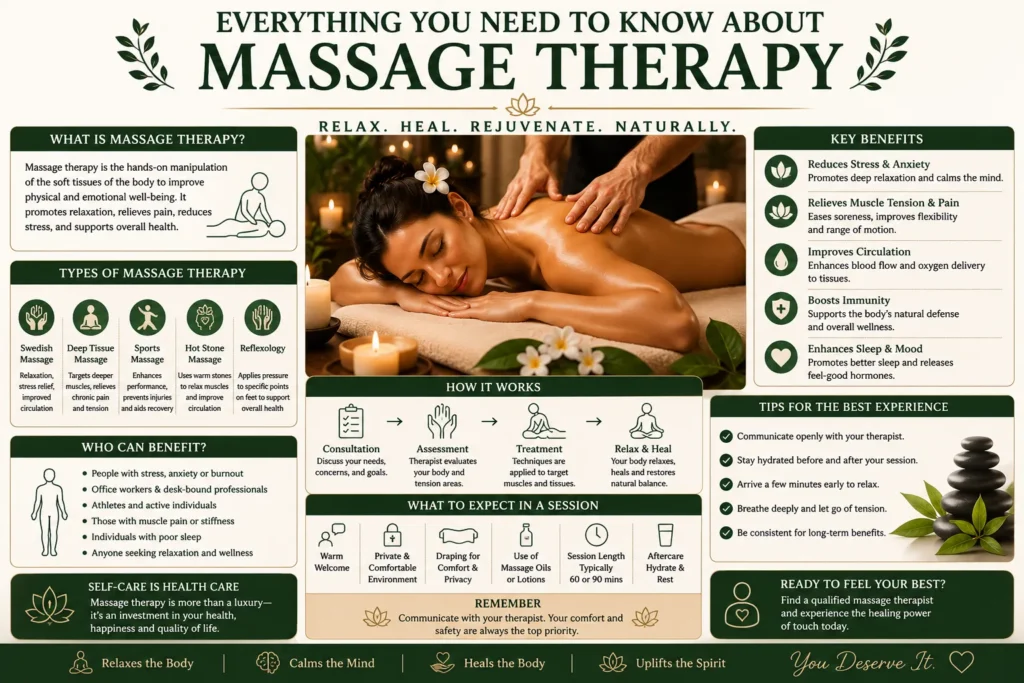
Everything You Need to Know About Massage Therapy
Massage therapy is practiced across more cultures and more centuries than almost any other wellness intervention. Understanding why it has persisted — and why modern versions of it remain among the most effective tools available for stress management and physical wellbeing — starts with understanding what it actually does.
What Massage Therapy Is
Massage therapy is the systematic application of touch — through pressure, movement, and directed manipulation — to the body’s soft tissues: skin, muscle, connective tissue, tendons, and ligaments.
The effects operate simultaneously across multiple physiological systems. Mechanically: massage compresses and mobilises muscle tissue, improving circulation and reducing the accumulation of metabolic waste. Neurologically: skilled sustained touch activates the parasympathetic nervous system, shifting the body from alert to rest. Biochemically: massage measurably reduces cortisol and increases oxytocin, serotonin, and dopamine.
These effects are not style-dependent. They occur whether the session is Swedish, deep tissue, sensual, or Nuru — because they arise from the fundamental act of skilled, sustained physical contact.
The Historical Record
The history of therapeutic touch is one of the most geographically widespread in the history of medicine.
Chinese texts from approximately 2700 BCE describe systematic therapeutic massage techniques. Egyptian tomb artwork from Saqqara (around 2330 BCE) depicts what appear to be massage procedures. Ayurvedic medicine — the ancient Indian healing system — developed an extraordinarily sophisticated framework for therapeutic touch that remains practised today.
Greek physicians, including Hippocrates himself, documented the therapeutic value of rubbing. The Romans adopted these practices extensively. Their thermal bath culture incorporated massage as standard health maintenance.
Swedish physician Per Henrik Ling formalised the Western massage tradition in the early nineteenth century, systematising techniques into the effleurage, petrissage, tapotement, friction, and vibration categories that remain the structural basis of Swedish massage today.
Contemporary massage therapy spans an extraordinarily wide range — from clinical physiotherapy-adjacent treatments to the luxury adult wellness services available in London’s professional market.
The Main Benefits
Stress and anxiety reduction. The most consistently documented benefit across research. A single session measurably reduces cortisol and increases oxytocin. Regular sessions maintain lower baseline stress levels between appointments.
Muscle tension relief. Direct pressure on muscle tissue releases chronic holding patterns. The specific technique varies by style; the physiological mechanism is consistent.
Circulation improvement. The mechanical effect of massage on soft tissue stimulates blood flow, improving oxygenation and metabolic waste clearance from tissues throughout the body.
Pain management. For lower back pain, tension headaches, fibromyalgia, and myofascial pain, massage therapy has shown clinically meaningful effects on pain intensity and frequency in multiple study cohorts.
Sleep quality. Clients consistently report improved sleep following regular massage. The neurochemical basis: reduced cortisol and increased serotonin, which is a melatonin precursor.
Emotional wellbeing. Touch is a primary human experience of safety and connection. In urban environments that restrict physical contact to close personal relationships, professional massage meets a genuine neurological need.
The Major Types Available in London
Swedish, deep tissue, sports, hot stone, aromatherapy, Thai, tantric, sensual, erotic, naturist, body-to-body, Nuru, couples, lingam, and full body.
Our complete massage types guide covers each in detail.
Choosing the Right Type
Three questions determine the choice:
What is your primary goal? (Therapeutic relief, general relaxation, sensory immersion, explicit pleasure, shared experience.)
What level of physical contact suits you? (Hands only, full-body therapist contact, or a spectrum between.)
What atmosphere fits you? (Clinical, spa-style, intimate and private.)
How Often to Book
For general wellness maintenance: every two to four weeks. For specific therapeutic goals: potentially weekly. For personal preference: as often as serves you. Many London clients maintain weekly routines as a consistent investment in their wellbeing.
Frequently Asked Questions
What are the main benefits?
Stress reduction, muscular tension release, improved circulation, pain management support, better sleep, and emotional wellbeing through the neurological effects of skilled touch.
Which type should I choose?
Depends on goal, preferred atmosphere, and comfort with physical contact. The massage types guide covers this in detail.
How often to book?
Every two to four weeks for maintenance. Weekly for therapeutic goals. As personal preference dictates.
What happens in a typical session?
A brief consultation, undressing to the appropriate level, the massage itself (60–90 min typically), and time to rest before leaving.